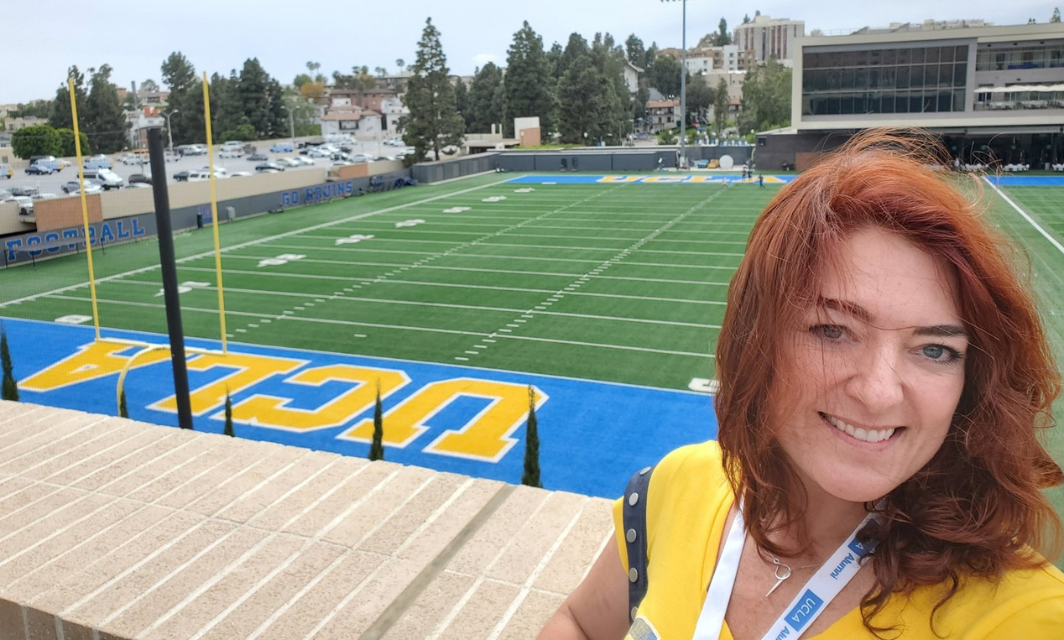
Ambassador Spotlight: Caroline Smith ’95, MBA ’02
What do UCLA and the Department of Anthropology mean to you?
UCLA has been part of my life for a very long time. I received both my undergraduate degree and my MBA from UCLA, so my connection to the university spans different stages of my life and career.
Anthropology, in particular, gave me a way of looking at the world that I still use today. Understanding culture, how people organize themselves, how they make decisions, and how their environment shapes behavior is relevant far beyond anthropology itself. Those ideas have stayed with me throughout my career and provided a framework to be successful.
How have you stayed engaged with UCLA and the Department of Anthropology since you attended UCLA?
Over the years, I have stayed involved through alumni and volunteer leadership, philanthropy, and the Chancellor’s Society. I served as President of the UCLA Anderson Alumni Los Angeles Chapter and have also served in leadership roles with the Chancellor’s Society, including the Collaboration Committee.
One of the things I have especially enjoyed has been returning to Anthropology to speak with students about careers. I have guest lectured on culture and successful business leadership and talked about how the skills developed through anthropology can be applied in business and many other fields.
That has been particularly rewarding because students do not always realize how broadly an anthropology education can be applied.
What first drew you to anthropology?
I have always been interested in people and culture. Not simply what people do, but why they do it and how their environment, history, social structures, and culture influence them.
Anthropology gives you the opportunity to be curious about an enormous range of subjects while also teaching you to look beyond the obvious explanation. That way of thinking appealed to me then as it does now.
Was there a particular person, experience, class, or idea that shaped your interest in the field?
One of the ideas from anthropology that has stayed with me is that you cannot fully understand behavior without understanding the culture and context surrounding it. That has proved remarkably applicable in my professional life. Organizations have cultures just as communities do, and understanding those cultures is often essential to understanding why an organization succeeds, struggles, or resists change.
That way of thinking has stayed with me, and I still find anthropology in unexpected places. One of my favorite recent examples is Sharks!, an art installation of giant fiberglass sharks located on the Regent’s Canal within the Borough of Hackney.
What made it especially interesting was the dispute with Hackney Council over planning rules and public space. The legal battle became part of the artwork itself, raising questions about authority, institutions, and who gets to decide what belongs. In many ways, it became a small battle between different cultures, each with its own rules, values, and view of the same space.
What inspired you to start this fellowship?
I wanted to do something meaningful in my Aunt Jacinta’s memory that reflected something we genuinely shared.
When I visited her in England, we would go to the British Museum together, particularly to see special exhibitions. Two that stand out in my memory are the Aztec and Terracotta Soldiers exhibitions. They gave us an opportunity to experience and learn about very different cultures together, and then, of course, talk about what we had seen afterward.
When I thought about honoring her, supporting students in Anthropology felt very natural. It connects my own UCLA education with something that Jacinta and I genuinely enjoyed together: curiosity about history, cultures, and people.
You generously made this gift in honor of your aunt. Is there anything you would like to share about her?
My Aunt Jacinta was very special to me, and I have wonderful memories of the time we spent together. She was someone with whom I could explore, learn, laugh, and be curious.
She passed away several years ago, and establishing the fellowship gave me a way to create something positive and lasting in her honor. I think she would have liked the idea that the fellowship might give a student the chance to explore something new, ask questions, and have experiences that stay with them long after they leave UCLA.
Why was student support particularly important to you?
Education opens doors, but some of the experiences that make an education truly transformative can be expensive.
In anthropology especially, opportunities such as research, fieldwork, travel, conferences, and internships can take students beyond the classroom, but they also create costs that not every student can easily absorb.
I wanted the fellowship to give a student a little more freedom to pursue an opportunity because it is academically valuable rather than having to decide whether they can afford it.
What are your hopes for the student recipients of your fellowship? What do you hope this fellowship makes possible for a student that might otherwise be difficult?
I hope it gives students options.
Perhaps it allows someone to participate in fieldwork, travel to conduct research, accept an internship, attend a conference, or pursue a project that would otherwise be financially difficult. I do not want to prescribe exactly what that opportunity should be because every student’s path will be different.
Ultimately, I hope the fellowship removes one obstacle between a student and an experience that could meaningfully shape their education or their future.
What opportunities do you hope the funding allows them to pursue: research, fieldwork, travel, internships, or something else?
Any of those. What matters most to me is that the student can pursue the opportunity that is most meaningful to their education. I deliberately do not want to define that opportunity too narrowly. Part of the value may be discovering a path they had not considered before.
Anthropology can lead in many directions. I would like the fellowship to help students explore those possibilities.
What does the UCLA Chancellor’s Society mean to you?
The Chancellor’s Society represents an amazing community of people who believe in UCLA and are dedicating in supporting its students, faculty, research, and the university’s broader mission.
What I appreciate about the Chancellor’s Society is that philanthropy at UCLA can take so many forms. People support the parts of the university that have meaning to them, and collectively those individual commitments can have an enormous impact.
For me, it is also another way to remain connected to a university that has given me a great deal.
What drove you to serve as a UCLA Chancellor’s Society Ambassador? What is your favorite part about being an Ambassador?
I enjoy connecting people together.
UCLA is an enormous institution, and there are extraordinary things happening throughout the university that alumni and supporters may simply never hear about. Being an Ambassador gives me an opportunity to help make some of those connections and help people discover programs, people, or areas of UCLA that resonate with them.
My favorite part is seeing someone find their own connection to UCLA. Philanthropy is much more meaningful when it reflects something the donor genuinely cares about.
Why is stewardship important to you?
To me, stewardship is about maintaining trust.
Making a gift should not be the end of the relationship. Donors should understand how their support is being used and, whenever possible, see the impact it is having.
Good stewardship also creates a connection between the donor and the people or programs they are supporting. In the case of my fellowship, that is particularly important to me. This gift has a very personal origin, and knowing that it is helping students creates a connection between my aunt’s memory, my own experience at UCLA, and future generations of Anthropology students.